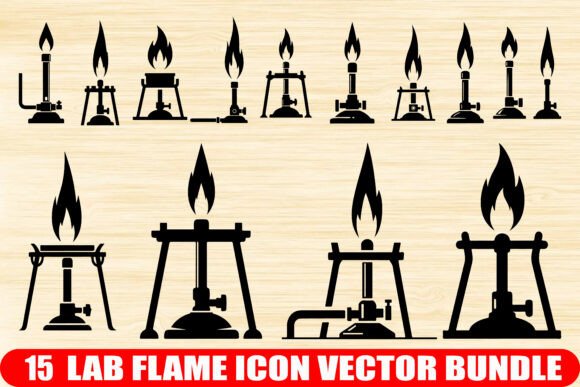
Why the 15 Lab Flame Icon Vector Bundle Bunsen Is Reshaping Science Communication for Modern Creators
In today’s fast-paced digital landscape—where clarity, speed, and visual consistency drive engagement—the demand for precision-crafted, context-aware design assets has never been higher. Enter the 15 Lab Flame Icon Vector Bundle Bunsen: a thoughtfully curated collection of laboratory flame and burner silhouettes that transcends typical icon packs by merging scientific authenticity with contemporary design sensibility. More than just decorative elements, these icons serve as functional visual shorthand—bridging complex chemistry concepts with intuitive, scalable communication.
A Tool Built for Clarity in an Age of Cognitive Overload
Modern audiences—whether students reviewing AP Chemistry material, startup founders launching science-edtech platforms, or marketing teams promoting lab-equipment SaaS—are overwhelmed by information density. Research from the Nielsen Norman Group confirms that users scan rather than read, relying heavily on visual cues to orient themselves. In this environment, a well-designed icon isn’t decorative—it’s cognitive infrastructure. The 15 Lab Flame Icon Vector Bundle Bunsen delivers exactly that: 15 clean, high-contrast silhouettes—each representing distinct flame configurations (Bunsen burners, microburners, roaring flames, pilot lights) and burner types—crafted to be instantly recognizable at any scale.
Unlike generic fire icons that risk misrepresenting scientific processes, these vector assets reflect real-world lab equipment. A subtle taper in the flame silhouette signals controlled combustion; a dual-port burner outline conveys adjustable air intake. That fidelity matters—not only for accuracy in educational publishing but also for brand credibility in science-forward industries like biotech startups, academic publishers, and STEM outreach nonprofits.
Scalability Meets Workflow Intelligence
The bundle’s technical foundation—15 SVG, 15 EPS, 15 AI, 15 PNG, 15 JPG, and 15 PDF files—isn’t just a checklist of formats. It reflects an understanding of how professionals actually work across disciplines:
- Designers open the AI or EPS files in Illustrator or Affinity Designer to recolor entire icon sets in under two minutes—aligning them with brand palettes without manual tracing.
- Educators and instructional designers drop transparent PNGs directly into Canva or Google Slides for lesson decks, knowing resolution won’t degrade when zoomed during live classroom demos.
- Print production teams use the embedded CMYK-ready EPS files for textbook illustrations or conference signage—no rasterization, no pixelation, no last-minute prepress fixes.
- Developers and UI/UX leads integrate SVGs into React or Vue components, leveraging native vector rendering for responsive web interfaces that load faster and scale flawlessly on retina displays.
This cross-platform readiness aligns with broader industry shifts toward unified asset systems. As creative teams increasingly operate in hybrid environments—juggling Figma prototypes, print collateral, merch production, and app UIs—the ability to deploy one source asset across all touchpoints eliminates redundancy, reduces version-control errors, and accelerates time-to-market.
Science Design Is No Longer Niche—It’s Strategic
Consider the rise of science-led consumer brands: probiotic supplements with molecular branding, climate-tech dashboards visualizing carbon flux, or CRISPR-based diagnostics using interactive explainer graphics. These aren’t fringe cases—they’re signals of a larger trend: scientific literacy is becoming a core component of brand voice. Consumers no longer accept vague “lab-tested” claims; they expect transparency, specificity, and visual proof.
The 15 Lab Flame Icon Vector Bundle Bunsen supports this shift by offering rigor where it counts. When a biotech startup illustrates its manufacturing process, using a stylized—but technically accurate—Bunsen burner icon communicates competence more effectively than a generic flame. When an edtech platform animates a chemistry simulation, pairing the icon with precise labeling (“adjustable air valve,” “blue cone = complete combustion”) builds trust through consistency.
This mirrors developments in regulatory design, too. Agencies like the FDA and EMA now encourage plain-language visuals in patient-facing materials. Icons grounded in real lab practice—like those in this bundle—help translate procedural accuracy into accessible imagery, reducing misinterpretation risks in safety documentation or compliance training.
Customization Without Compromise
One persistent pain point for creatives is “customizable-but-fragile” assets: icons that look great out-of-the-box but fall apart when edited. The 15 Lab Flame Icon Vector Bundle Bunsen avoids this trap through intentional construction. Each vector path is simplified yet anatomically sound—no unnecessary anchor points, no overlapping fills that cause rendering glitches. This means:
- You can change stroke weight to emphasize hierarchy in infographics—thicker outlines for primary reaction steps, thinner ones for supporting apparatus.
- You can layer multiple icons (e.g., flame + flask + thermometer) without alignment drift, thanks to consistent baseline grids and bounding boxes.
- You can export single-color variants for embroidery on lab-coat patches or laser-engraved on glassware packaging—without losing crispness.
That reliability matters most in high-stakes contexts: imagine a university press releasing a new open-access chemistry textbook. With tight deadlines and multi-format output requirements (PDF, EPUB, web), having a single, editable vector source eliminates the need to commission separate versions for print vs. screen—saving budget and preserving visual continuity.
From Classroom Walls to Global Campaigns
Real-world adoption reveals deeper utility. A university communications team recently used four icons from the bundle to redesign their annual research symposium identity—integrating flame silhouettes into the logo lockup, session banners, and mobile app navigation. Feedback showed improved attendee recognition of chemistry-focused tracks, even among non-specialist faculty.
Similarly, a European science outreach NGO deployed the icons across bilingual posters, animated Instagram carousels, and tactile learning kits for visually impaired students—leveraging the SVG’s accessibility metadata and clean geometry to support screen-reader compatibility and raised-line printing.
These examples underscore a quiet but powerful evolution: science visualization is moving from static illustration to modular, interoperable system design. The 15 Lab Flame Icon Vector Bundle Bunsen doesn’t just provide assets—it provides grammar. A shared visual vocabulary that scales from micro-interactions (a hover effect revealing flame temperature ranges) to macro-narratives (a campaign illustrating energy transformation across renewable tech).
Future-Ready, Not Just Trend-Ready
As generative tools mature and AI-assisted design becomes routine, the value of human-curated, domain-specific assets grows—not shrinks. Algorithms can generate infinite flame icons, but they rarely understand why a blue inner cone matters more than flame height in Bunsen burner operation. That nuance requires subject-matter awareness, not just prompt engineering.
The 15 Lab Flame Icon Vector Bundle Bunsen represents a deliberate counterpoint to synthetic abundance: focused, expert-informed, and engineered for longevity. Its minimal style ensures relevance beyond current aesthetic cycles; its technical robustness ensures compatibility with emerging standards like SVG 2.0 and CSS container queries.
For professionals who build meaning—not just pixels—this bundle isn’t just another download. It’s infrastructure for integrity. A small but significant way to ensure that every time science enters public view, it does so with clarity, authority, and quiet confidence.