Disaster Risk Icon Pack
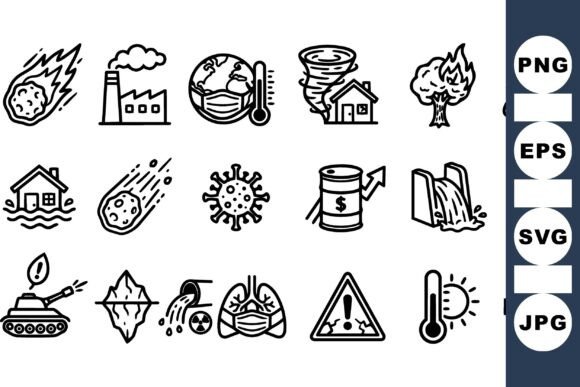
The Disaster Risk Icon Pack is a curated line art icon set designed to visually represent natural and human-caused hazards. It includes scalable vector and raster formats—SVG, EPS, JPG, and PNG—delivered in a single downloadable ZIP file. Each icon follows a consistent, minimalist aesthetic: monochrome, high-contrast, and intentionally stark, prioritizing clarity over ornamentation.
This pack is not a general-purpose symbol library. It focuses narrowly on disaster-related concepts: earthquakes, floods, wildfires, chemical spills, structural collapse, power outages, tsunamis, tornadoes, pandemics, industrial accidents, and related preparedness or response actions (e.g., evacuation, shelter-in-place, hazard signage). Its design language supports legibility at small sizes and adaptability across print and digital media.
Who Might Consider the Disaster Risk Icon Pack?
Designers, educators, emergency management professionals, public health communicators, and editorial teams often seek icons that communicate risk without ambiguity. The Disaster Risk Icon Pack appeals most directly to those who need:
- Consistency in safety messaging: Teams developing standardized infographics, hazard maps, or multilingual emergency guides benefit from a unified visual vocabulary.
- Technical flexibility: Projects requiring both web-ready SVGs and print-safe EPS files—such as government handouts, NGO training materials, or interactive dashboards—can use the same source assets across outputs.
- Neutral, non-sensational representation: The stark line art avoids emotional exaggeration, supporting factual, calm communication appropriate for official guidance or academic contexts.
Practical Benefits and Realistic Tradeoffs
One key strength is format versatility. SVG files scale infinitely without quality loss, making them ideal for responsive web interfaces or large-format posters. EPS ensures compatibility with professional print workflows. JPG and PNG offer immediate usability in presentations or content management systems where vector support is limited.
However, this versatility comes with constraints. The pack contains no color variants—icons are delivered in black-on-transparent or black-on-white configurations only. Users needing custom color palettes must edit files manually or apply CSS filters (for SVG) or image-processing tools (for raster formats). There are no animated versions, layered PSD files, or icon fonts included—only flat, static assets.
Another consideration is scope. With approximately 40–60 distinct icons (depending on version), the set covers core disaster categories but omits niche or region-specific hazards—such as volcanic lahars in certain geographies or cyber-physical infrastructure failures. It also does not include pictograms for recovery phases (e.g., rebuilding, mental health support) or socioeconomic dimensions of risk (e.g., displacement, supply chain disruption).
When This Pack Aligns Well With Your Needs
The Disaster Risk Icon Pack is a strong fit if your project emphasizes clarity, speed of implementation, and cross-platform consistency. For example:
- You’re producing a municipal flood preparedness brochure and need clean, scalable icons for evacuation routes, sandbag stations, and water contamination warnings—assets you can place directly into InDesign or Illustrator without redesigning.
- Your team maintains an internal knowledge base for industrial safety protocols and requires reusable, license-compliant icons to illustrate lockout/tagout procedures, confined space entry, or hazardous material handling.
- You’re building a public-facing dashboard tracking real-time hazard alerts and want lightweight SVG icons that load quickly and remain sharp on mobile screens and desktop displays alike.
In these cases, the pack reduces decision fatigue: its focused scope means less time sorting through irrelevant symbols, and its technical readiness minimizes pre-production file conversion work.
When Alternatives May Be More Appropriate
Consider other options if your goals involve:
- Custom illustration needs: If your brand guidelines require bespoke iconography—such as illustrated characters, contextual scenes, or culturally specific symbolism—the Disaster Risk Icon Pack’s standardized line art may feel too generic. Commissioning original artwork or selecting a more stylistically flexible library would better serve long-term brand alignment.
- Dynamic or interactive use: Projects requiring hover states, transitions, or data-driven icon changes (e.g., severity-level coloring, animated warning pulses) benefit more from icon systems built with CSS variables or JavaScript integration—capabilities outside this pack’s static asset model.
- Broad thematic coverage: If your work spans disaster risk alongside climate adaptation, sustainability metrics, or community resilience frameworks, you may need complementary sets—for instance, icons for carbon footprint, renewable energy, or social cohesion—that this pack does not provide.
Making an Informed Decision
Evaluating the Disaster Risk Icon Pack starts with clarifying your primary use case—not just what you want to depict, but how and where it will be used. Ask yourself:
- What formats do my production tools actually support? If your workflow relies heavily on Adobe Creative Cloud, EPS and SVG compatibility matters. If you're embedding icons in WordPress or a static site generator, SVG and PNG are likely sufficient.
- How much post-download editing am I prepared to do? If you lack vector editing software or time to adjust stroke weights, colors, or spacing, a ready-to-use PNG set with varied sizing may be more efficient—even if less future-proof.
- Does consistency outweigh stylistic uniqueness? A uniform visual language improves comprehension in safety-critical contexts, but may feel impersonal in advocacy campaigns aiming to evoke empathy or urgency.
Licensing is another practical factor. Confirm whether the pack permits commercial use, redistribution in derivative works (e.g., integrated into a licensed software tool), or modification—details typically outlined in the license agreement accompanying the download. Public sector or nonprofit users should verify compliance with procurement policies before deployment.
Finally, assess scalability beyond the immediate project. If you anticipate expanding into adjacent topics—like climate vulnerability indicators or infrastructure resilience metrics—you might prioritize a modular icon system where new symbols follow the same design logic, rather than a fixed, closed set.
In summary, the Disaster Risk Icon Pack serves a precise function: delivering technically sound, visually restrained representations of hazards for clear, functional communication. Its value lies not in breadth or stylistic novelty, but in reliability, interoperability, and purpose-built focus. Whether it meets your needs depends less on its features in isolation and more on how closely those features map to your actual production constraints, audience expectations, and long-term communication strategy.