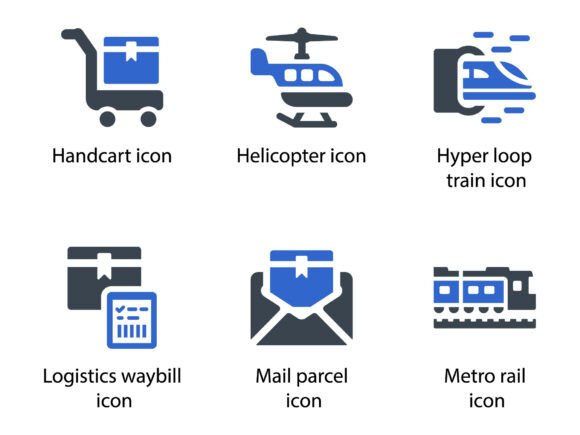
Transport and Logistics Icon Set 4
Transport and Logistics Icon Set 4 is a curated collection of 6 scalable, professionally crafted glyph icons focused on modern and traditional transportation and logistics concepts. The set includes Handcart, Helicopter, Hyperloop train, Logistics waybill, Mail parcel, and Metro rail — each rendered with consistent line weight, balanced proportions, and thoughtful negative space. Designed for clarity at multiple sizes, the icons are delivered in three widely supported formats: EPS (for vector editing in Adobe Illustrator or CorelDRAW), SVG (for responsive web use and code integration), and PNG (in multiple resolutions, including 256×256, 512×512, and 1024×1024 pixels).
This icon set serves designers, developers, educators, and marketing professionals who need accurate, stylistically unified visuals to represent movement, delivery, infrastructure, and supply chain operations. Unlike generic clipart or inconsistent free icon packs, Transport and Logistics Icon Set 4 prioritizes conceptual fidelity — for example, the Hyperloop train icon conveys speed and enclosed tube transport without relying on literalism, while the Logistics waybill avoids excessive detail that would degrade legibility at small sizes.
One reason someone might consider this set is its intentional scope. With only six icons, it avoids bloat while covering key categories: ground freight (Handcart), air transport (Helicopter), high-speed rail (Hyperloop train), urban transit (Metro rail), last-mile delivery (Mail parcel), and documentation (Logistics waybill). This narrow focus supports visual consistency across interfaces or documents — a practical advantage when building dashboards, infographics, or training materials where thematic cohesion matters more than exhaustive coverage.
The inclusion of EPS, SVG, and PNG files addresses common workflow needs. Designers working in print or large-format layouts benefit from the resolution-independent EPS files. Developers embedding icons directly into HTML or CSS can use the clean, lightweight SVGs — which support color customization via CSS and scale without pixelation. PNG files offer immediate usability in PowerPoint, Keynote, or PDF-based presentations where vector support is limited or unpredictable. No font-based implementation is involved, eliminating issues related to font loading, licensing, or rendering inconsistencies across devices.
However, users should consider tradeoffs before adopting Transport and Logistics Icon Set 4. Its limited count means it does not cover adjacent concepts like cargo ship, bicycle courier, warehouse, drone delivery, or customs documentation. If a project requires broader representation — such as a global logistics platform needing maritime and cross-border symbols — supplementing this set with additional assets may be necessary. Similarly, the glyph style emphasizes minimalism and abstraction; users seeking pictorial, isometric, or illustrated icons will find this set stylistically mismatched.
Another consideration is licensing and usage rights. While the set permits commercial use, redistribution, or resale of the icons as standalone assets is typically prohibited. Users integrating icons into templates, SaaS dashboards, or white-labeled tools should verify the license terms apply to their specific deployment context — especially if end users will edit or export those icons independently.
Transport and Logistics Icon Set 4 is a strong fit for specific scenarios. It works well when designing internal operational dashboards for logistics teams, where clarity and quick recognition outweigh decorative flair. It suits educational materials explaining supply chain stages — for instance, using the Mail parcel icon to denote final delivery and the Logistics waybill to represent documentation flow. It also supports printed safety guides, process maps, or compliance checklists where vector precision ensures sharp output on paper or signage. Because each icon maintains equal visual weight and spacing, it integrates cleanly into grid-based layouts without manual alignment adjustments.
Conversely, alternatives may be preferable in other situations. For websites targeting general consumers — such as e-commerce delivery trackers or ride-hailing apps — more expressive or friendly icon styles (e.g., outlined with subtle shadows, rounded corners, or motion cues) often improve perceived usability. In those cases, a larger, thematically flexible icon library — like Font Awesome’s transport category or Noun Project’s licensed collections — offers greater flexibility, even if individual icons vary slightly in style. Similarly, projects requiring animation (e.g., an interactive map showing real-time vehicle movement) benefit from SVG paths designed with animation-ready structure — a trait not guaranteed in all glyph sets, including this one.
Practical decision-making starts with clarifying intent. Ask: Is the goal to communicate precise logistics functions — like documentation handoff or multimodal transit — or to evoke a general sense of movement and service? If the former, Transport and Logistics Icon Set 4’s deliberate naming and conceptual rigor supports accuracy. If the latter, a broader or more stylistically varied set may better serve tone and audience expectations.
Also consider technical constraints. Projects built with strict design systems may require icons to follow specific stroke widths, corner radii, or grid alignments. Reviewing the provided SVG source code or opening the EPS files in a vector editor helps confirm compatibility with existing guidelines. If your team uses icon libraries managed through npm or CDN, manually integrating these static files adds minor overhead versus auto-updating packages — though that tradeoff is often acceptable for specialized, high-fidelity assets.
Finally, evaluate scalability beyond the current project. If you anticipate needing icons for aviation regulation, cold-chain logistics, or port operations in the future, starting with a narrowly scoped set like Transport and Logistics Icon Set 4 can still be strategic — as long as you plan for modular expansion. Its cohesive foundation makes adding complementary icons later more manageable than retrofitting inconsistent assets into an established visual language.
In summary, Transport and Logistics Icon Set 4 is most valuable when precision, consistency, and format versatility matter more than quantity or stylistic variety. It meets a specific niche: professionals who need trustworthy, production-ready icons for transport- and logistics-focused communication — without unnecessary complexity or ambiguity. Choosing it reflects a preference for intentionality over abundance, and clarity over ornamentation.