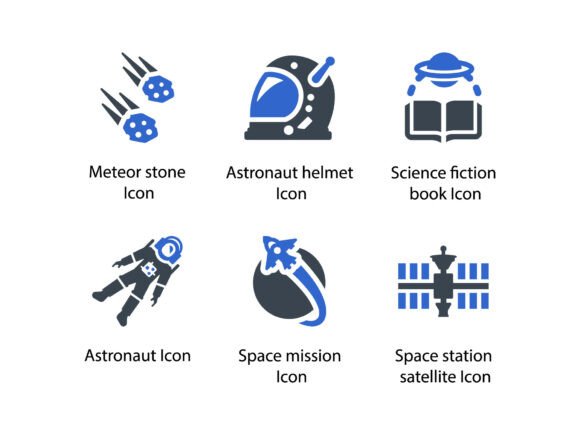
Space Icon Set 2: A Practical Evaluation for Designers and Developers
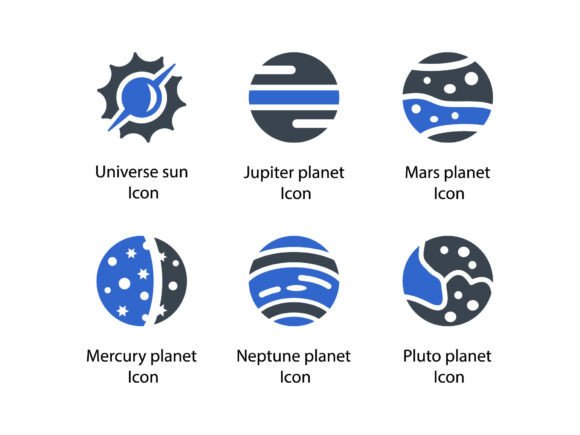
Space Icon Set 2 is a curated collection of vector and raster icons centered on space exploration, science fiction, and astronomical themes. It includes twelve distinct glyphs—such as Meteor stone, Astronaut helmet, Science fiction book, Astronaut, Space mission, and Space station—delivered in EPS, SVG, and PNG formats. Unlike generic icon libraries, this set emphasizes visual cohesion, consistent stroke weight, balanced negative space, and scalable precision. It is intended for professionals who require thematic consistency across digital and print outputs without compromising technical flexibility.
Why Designers and Communicators Consider Space Icon Set 2
Designers often seek icon sets when building interfaces or visuals around specific subject areas. For projects related to astronomy education, STEM outreach, sci-fi branding, aerospace documentation, or interactive learning tools, thematic relevance matters. Space Icon Set 2 addresses that need directly: each glyph reflects a recognizable concept within the broader space domain while maintaining stylistic unity. This reduces visual friction in infographics, slide decks, or web dashboards where clarity and quick recognition are essential.
Developers evaluating assets for front-end implementation may also find value in the format diversity. The inclusion of SVG ensures responsive rendering across devices and screen densities, while EPS supports high-fidelity output for printed reports or large-format posters. PNG files—available in multiple resolutions—offer immediate usability in environments where vector support is limited or where rapid prototyping is required.
Key Benefits and Real-World Utility
The primary benefit of Space Icon Set 2 lies in its purpose-built coherence. Icons like Astronaut helmet and Space station share proportional relationships, line thickness, and corner treatment, allowing them to function as a system—not just individual assets. This consistency supports scalable design systems, especially when creating modular UI components or branded documentation templates.
Technical accessibility is another advantage. SVG files are editable in code (e.g., via CSS fill color changes or inline optimization), and EPS compatibility enables integration into professional print workflows using Adobe Illustrator or CorelDRAW. PNG variants provide fallbacks for legacy CMS platforms or email clients with limited SVG support.
For educators or nonprofit communicators producing public-facing materials—such as brochures about planetary science or classroom posters on rocketry—the set offers ready-to-use, royalty-free visuals that avoid the ambiguity of stock imagery or inconsistent free icon packs.
Tradeoffs and Important Considerations
While Space Icon Set 2 excels in thematic focus and technical quality, it does not aim for breadth. With only twelve glyphs, it lacks the scale of comprehensive icon libraries such as Font Awesome or Material Icons. Users needing hundreds of symbols—or icons covering adjacent domains like climate science, robotics, or general technology—will likely need to supplement this set with additional resources.
Stylistically, the glyphs follow a clean, minimalist glyph aesthetic. They prioritize legibility at small sizes and adaptability across backgrounds but do not include expressive variations (e.g., outlined vs. filled versions, animated states, or alternate perspectives). Designers seeking stylistic flexibility—such as hand-drawn, isometric, or 3D-rendered interpretations—may find the set too restrained for certain brand voices.
Licensing terms should also be verified before deployment. Although the set is marketed for commercial use, users must confirm whether redistribution, modification, or embedding in SaaS products falls within the permitted scope. Some license agreements restrict usage in templates sold to third parties—a detail relevant for agencies or theme developers.
Situations Where Space Icon Set 2 Is a Strong Fit
This set is particularly well-suited for focused, domain-specific applications. Examples include:
- Creating a cohesive visual language for an astronomy outreach website or mobile app interface;
- Designing presentation decks for university courses on space policy or astrophysics;
- Producing printed educational materials—such as student workbooks or museum exhibit signage—where vector fidelity and scalability are critical;
- Building internal dashboards for aerospace startups tracking mission milestones, crew training, or equipment status;
- Developing branded infographics for science communication nonprofits explaining orbital mechanics or satellite networks.
In each case, the limited but intentional scope of Space Icon Set 2 becomes an asset rather than a limitation. Fewer options reduce decision fatigue and support faster, more consistent execution.
When Alternatives May Be More Appropriate
Projects requiring broad icon coverage—such as enterprise software with dozens of functional modules—may benefit more from extensible icon fonts or scalable icon services offering search, filtering, and version control. Similarly, teams working under tight deadlines and unfamiliar with vector editing may prefer icon sets with built-in Figma or Sketch plugins that simplify insertion and styling.
If a project demands strong narrative or emotional resonance—such as a children’s book app or a cinematic promotional campaign—illustrative or pictorial icons (rather than glyph-style abstractions) could better serve the communication goal. In those cases, custom illustration or curated pictorial icon libraries may align more closely with audience expectations.
Finally, budget-conscious users evaluating free alternatives should weigh tradeoffs carefully. While many open-source icon repositories offer space-themed symbols, inconsistencies in sizing, alignment, or file structure can increase integration time. Space Icon Set 2’s uniform construction may offset its cost through reduced QA and revision cycles.
Making an Informed Decision
Before selecting Space Icon Set 2, consider three practical questions:
- Does your project revolve primarily around space-related topics? If more than 60% of your required icons fall within this domain—and you anticipate reusing them across multiple deliverables—the set’s cohesion pays dividends.
- Do you need both digital and print-ready assets? If your workflow involves exporting to PDF reports, large-format posters, or embedded web graphics, the inclusion of EPS and SVG makes this set technically versatile.
- Is consistency more valuable than variety in your context? If your team prioritizes speed, maintainability, and visual reliability over stylistic experimentation, Space Icon Set 2 supports those goals effectively.
Conversely, if your needs span multiple unrelated themes, require frequent stylistic adaptation, or involve collaborative design systems with strict tokenization requirements, a broader or more modular solution may prove more sustainable long term.
Ultimately, Space Icon Set 2 serves a defined niche well—not as a universal toolkit, but as a precise instrument for communicators and creators whose work orbits the themes of exploration, discovery, and scientific imagination.